Picture this: a tiny air leak lets powder slip past the valve.Your dust collector struggles. Airflow drops. The line stops. One small part just took out your shift.
A rotary airlock valve sits between hoppers, dust collectors and pipes that move product with air.
Its job is simple: let material through, keep the air where it belongs.
Pick the right valve and you protect uptime, product quality and energy. Pick the wrong one and you get leaks, dust, line blockages and constant cleaning.
How do you choose the right rotary valve to avoid downtime, dust and contamination?
Start with four basics: what you’re moving, how clean it must be, the pressure you run, and how much you need to move
Choose a rotor style and seals that suit the material. Keep the gap between rotor and body tight.
Run at a sensible speed so each pocket fills well. If you need more flow, use a bigger valve, not more RPM.
For explosion isolation, keep that gap about 0.2 mm (0.0079 in). As a rule of thumb, keep tip speed under ~40 m/min.
Benchmark
- Pocket fill (how full each pocket gets): plan around ~70% for powders and ~50% for pellets/granules.
- Tip speed cap (~40 m/min) is widely used by OEMs because pocket fill falls off above that.
- If your sizing only works at high RPM, your valve is too small.
Failure #1: Dust is escaping the valve
A light powder halo near the housing usually means air is slipping past seals or rotor tips. Your dust collector is doing extra work because the valve isn’t sealing.
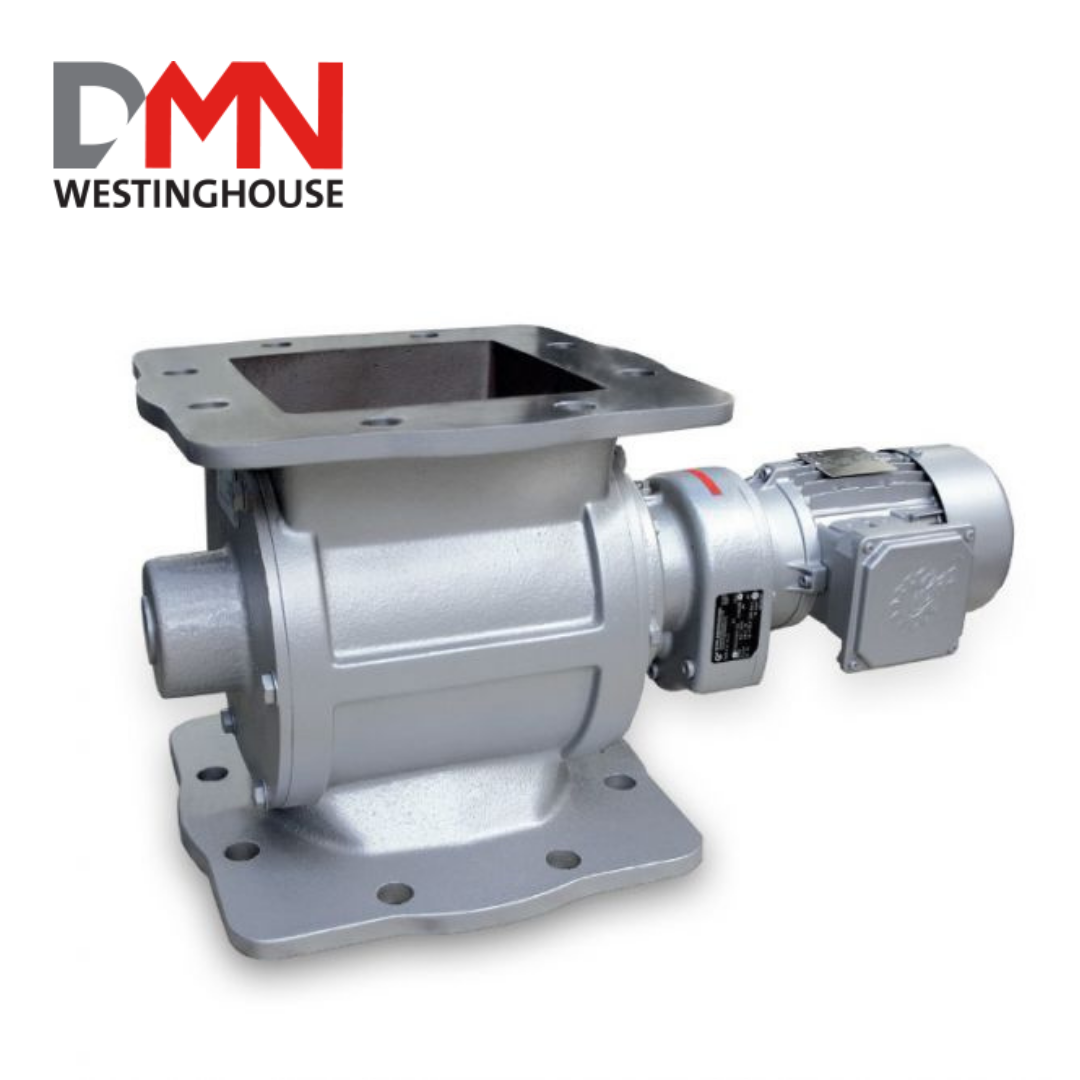
DL Rotary Valves DMN-WESTINGHOUSE
What to do now
- Set a small air-purge at the seal just above internal pressure, so clean air leaks out (not dust in).
- Bring the valve back to spec clearances; check tips and endplates for wear.
- If the duty involves isolation, keep the rotor-to-body gap ~0.2 mm (0.0079 in), temperature dependent.
Good fit to explore: DL Dust-Lock Rotary Valve — built to keep fine powders in and air where it should be.
Failure #2: Cleaning steals half your shift
Sticky residue and slow strip-downs aren’t a cleaning problem; they’re a design problem. Rough internals hold on to the product, and access is too hard.
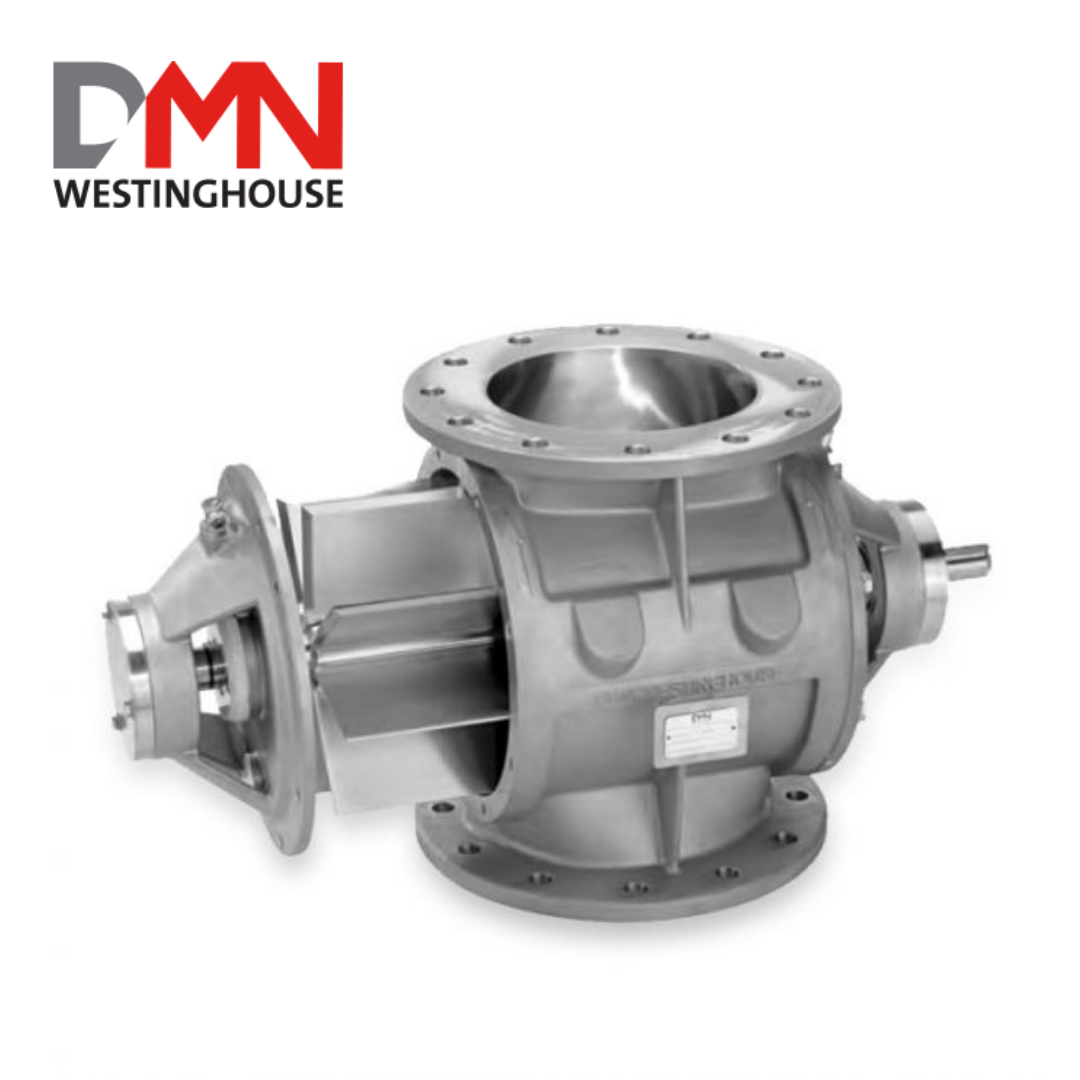
AML Rotary Valves DMN-WESTINGHOUSE
What to do now
- Specify stainless with polished internals; move to quick-clean endplates or slide-out rotors on rails.
- Standardise a fast changeover: open, wipe, verify, close — in minutes, not hours.
- If you convey with air, consider blow-through to leave less product in the pockets.
Good fit to explore: AXL Dairy Rotary Valve — hygienic, drop-through, built for powders.
(Full stainless option: USAL. Tight batching: SAL. Hygienic blow-through: BL/BXL.)
Failure #3: The pneumatic line won’t settle
Choppy transfer and rising blower power point to two things: leakage through the valve, or pockets not filling because you’re spinning too fast.
What to do now
- Keep tip speed ≤ ~40 m/min; faster looks good on paper but fills worse.
- In vacuum/low-pressure duty, use a pressure-rated airlock and hold tolerances tight.
- For conveying, switch to blow-through discharge so pockets empty into the airstream.
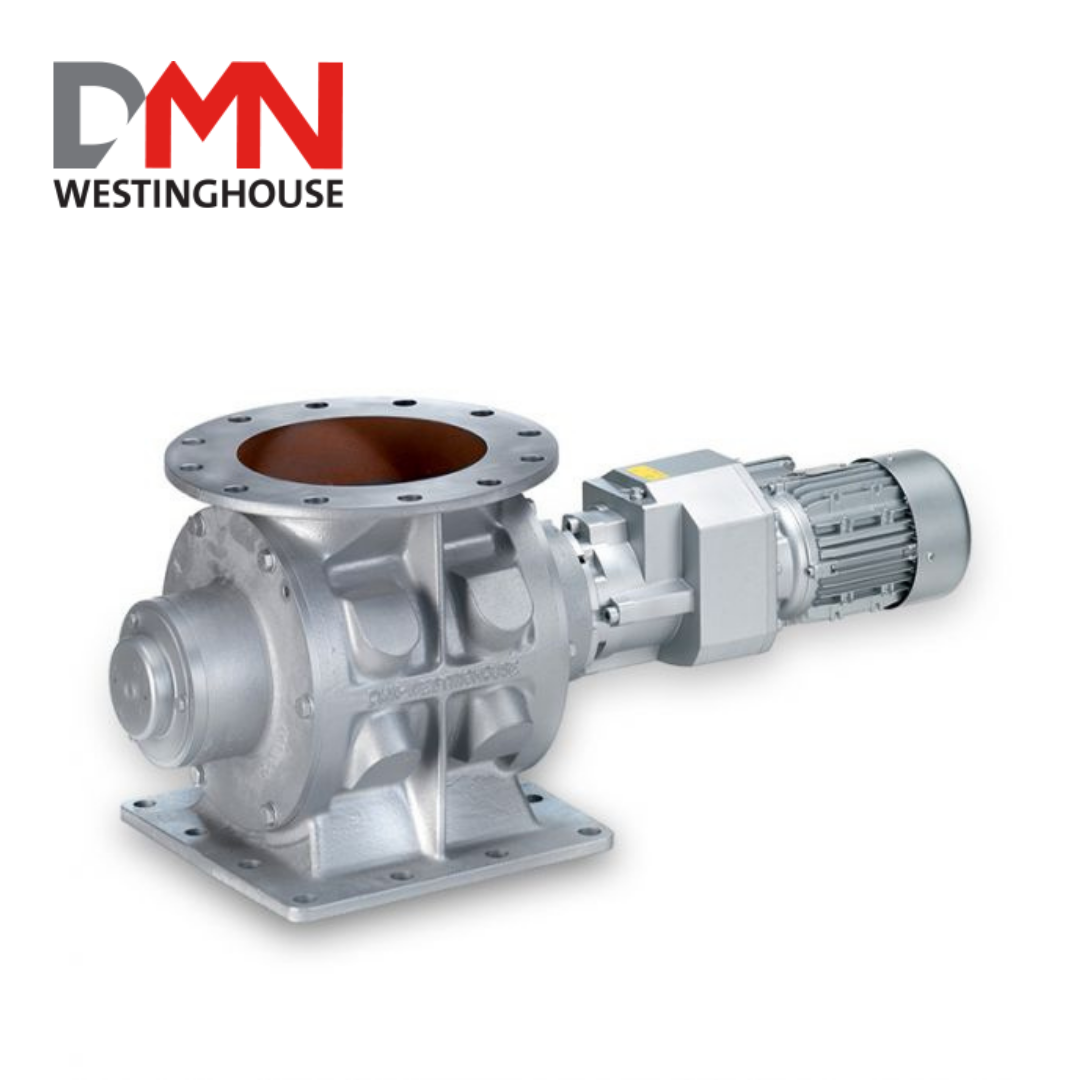
Good fit to explore: MLD Rotary Valve — built for vacuum and low-pressure systems
Failure #4: Bridging at the inlet; downstream is starving
If operators are tapping the hopper and the rate still dips, the valve throat or bore is too small for the particle size and flow you need.
What to do now
- Size to realistic pocket-fill: ~70% for powders; ~50% for pellets/granules.
- If you’re near the limit at sensible RPM (often ≤ 25 rpm on smaller rotors), go up a size.
- For coarse or flaky products, use a larger inlet to stop hang-ups at the mouth.
Good fit to explore: AML Large-Inlet Rotary Valve — bigger mouth, fewer blockages, steadier feed.
Failure #5: Abrasive duty opens the clearances
Fly ash, cement and silica don’t just wear parts; they open the gaps that keep air where it belongs. Starts fine, ends leaky.
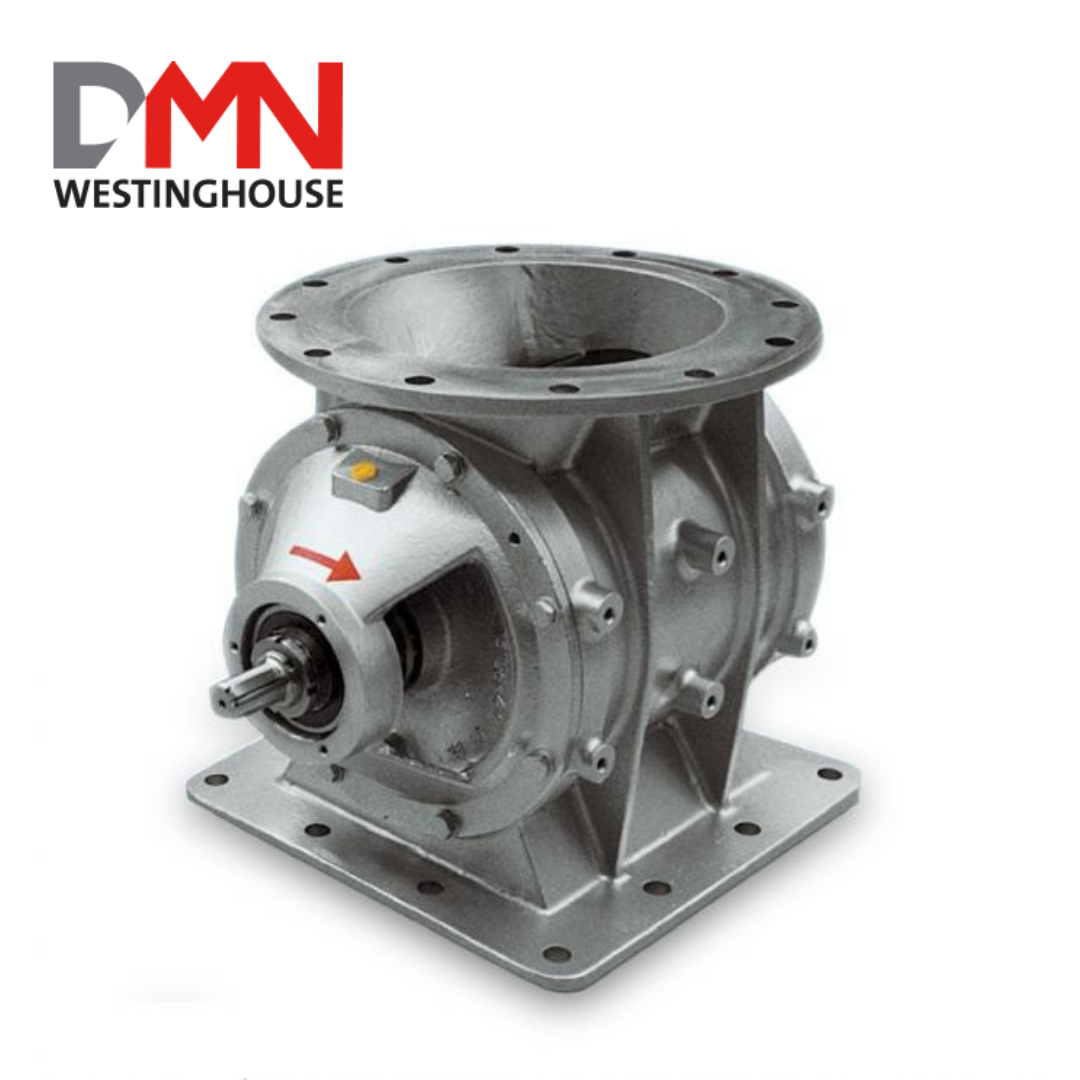
L Rotary Valves DMN-WESTINGHOUSE
What to do now
- Move to hardened or replaceable rotor tips and a wear-lined bore to hold geometry.
- If the product is coarse as well as abrasive, pick a granular rotor that won’t bridge.
- Put a quarterly clearance check in the PM plan; isolation duties need that ~0.2 mm gap held.
Good fit to explore: GL Granular Rotary Valve — built for bulk solids with options for
Spec-and-select checklist
- Material & behaviour: fine powders, sticky products, abrasive materials, particle size, moisture.
→ Dust-tight fines: DL Dust-Lock • Granules: GL Granular - System pressure: vacuum/low-pressure; drop-through vs blow-through.
→ Vacuum/low-pressure: MLD • Blow-through: BL/BXL Dairy - Throughput: design to a pocket fill you’ll actually hit; keep tip speed ≤ ~40 m/min; RPM often ≤ 25 on smaller rotors.
→ If size is the constraint: AML Large-Inlet - Hygiene: stainless, polished, quick-clean/CIP.
→ AXL Dairy • USAL • SAL
Isolation & safety: keep the rotor-to-body gap ~0.2 mm where isolation is required; confirm clearances after any hot run-in or abrasive campaign.
Rotary valve styles — quick guide (decision tool)
| Use-case | What matters | LGPM Fit | Why it helps |
| Hygienic powders (milk, whey, sugar) | Stainless, fast clean | AL/AXL Dairy Rotary Valve | Smooth internals reduce residue; quicker sanitation |
| Hygienic pneumatic transfer | Blow-through, less hold-up | BL/BXL/BXXL Rotary Valve | Empties pockets into airflow; cleaner lines |
| Full sanitary build | 304/316 SS, polished, CIP | USAL Rotary Valves | Compliance-friendly construction |
| Precision dosing | Accuracy and quick clean | SAL Rotary Valves DMN | Steady feed; fast changeovers |
| Dust-tight for fines | Seals + tight clearances | DL Rotary Valves | Keeps powders in; protects air balance |
| Granules / pellets | Throat geometry | GL Rotary Valves | Reduces bridging; protects product |
| Vacuum / low-pressure | Airtight tolerances | MLD Rotary Valves | Maintains stable pressure for smoother conveying |
| High capacity / coarse | Large mouth, robust build | AML Rotary Valves | Fewer blockages; higher stable rate |
Case Study - Food: Dust under control
The situation
A dairy plant ran cast-iron drop-through valves on milk powder.
Moisture made the powder tacky. Pockets packed. The shaft seal leaked.
The dust collector ran hard and the line stopped too often.
What we changed
- Swapped to a stainless, quick-clean sanitary valve with polished internals.
- Upgraded shaft seals and added a light air purge.
- Moved to a rail-out design so the rotor slides out in minutes.
Results
- Clean-down per changeover: 180 → 120 minutes (-33%).
- Unplanned stoppages for build-up: 2–3/month → 0–1/month.
- Dust collector ΔP: stable within spec during long runs.
“We were losing half a day every week to sticky build-up and leaky seals.
The stainless valve with a small purge cut cleaning by a third, and hygiene audits have been boring ever since.”
— Mark T., Production Manager, Australian Dairy Processor
Related LGPM solution: AXL Dairy Rotary Valve
Case Study - Mining: Built to resist wear
The situation
A fly-ash transfer line chewed through rotors in under a year.
Abrasive dust and heat opened up the clearances.
Pressure control wandered and conveying became unreliable.
What we changed
- Fitted hardened, replaceable rotor tips and a wear-lined bore.
- Moved to a large-inlet housing to stop bridging at the cyclone outlet.
- Set a quarterly check on rotor–housing clearances.
Results
- Rotor/liner life: 9–12 months → 30–36 months (~3×).
- Line ΔP variation: ±18% → ±6% (much steadier flow).
- Maintenance call-outs: monthly → quarterly.
“Fly ash used to eat rotors for breakfast.
The large-inlet, wear-lined build tripled life and finally stabilised pressure.
We’ve gone from constant rebuilds to planned swaps.”
— Sarah K., Maintenance Supervisor, WA Mining Operation
Related LGPM solution: AML Large-Inlet Rotary Valve Rotary valves decide if your line runs
Rotary valves decide if your line runs clean and steady or leaky and slow.
Keep gaps tight. Keep speeds sensible. Choose the rotor and seals for the material.
Size the valve to the rate you really need — and use the bore, not RPM, to get there.
Talk to our engineers or request a tailored quote.
We’ll match a valve to your process that keeps uptime high, dust under control and product quality consistent.
Related Posts

Happy National AgDay | Celebrate Aussie farming!
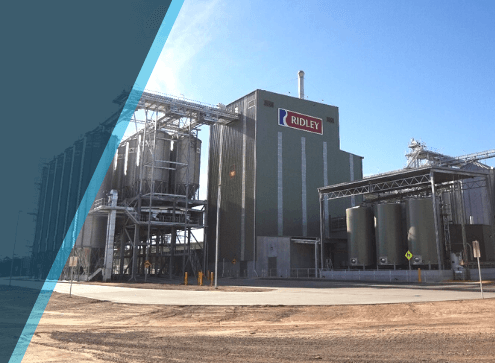
Ridley Bendigo Monogastric Feedmill